> For the complete documentation index, see [llms.txt](https://docs.rierino.com/llms.txt). Markdown versions of documentation pages are available by appending `.md` to page URLs; this page is available as [Markdown](https://docs.rierino.com/devops/microservices/deployment-packages.md).
# Deployment Packages
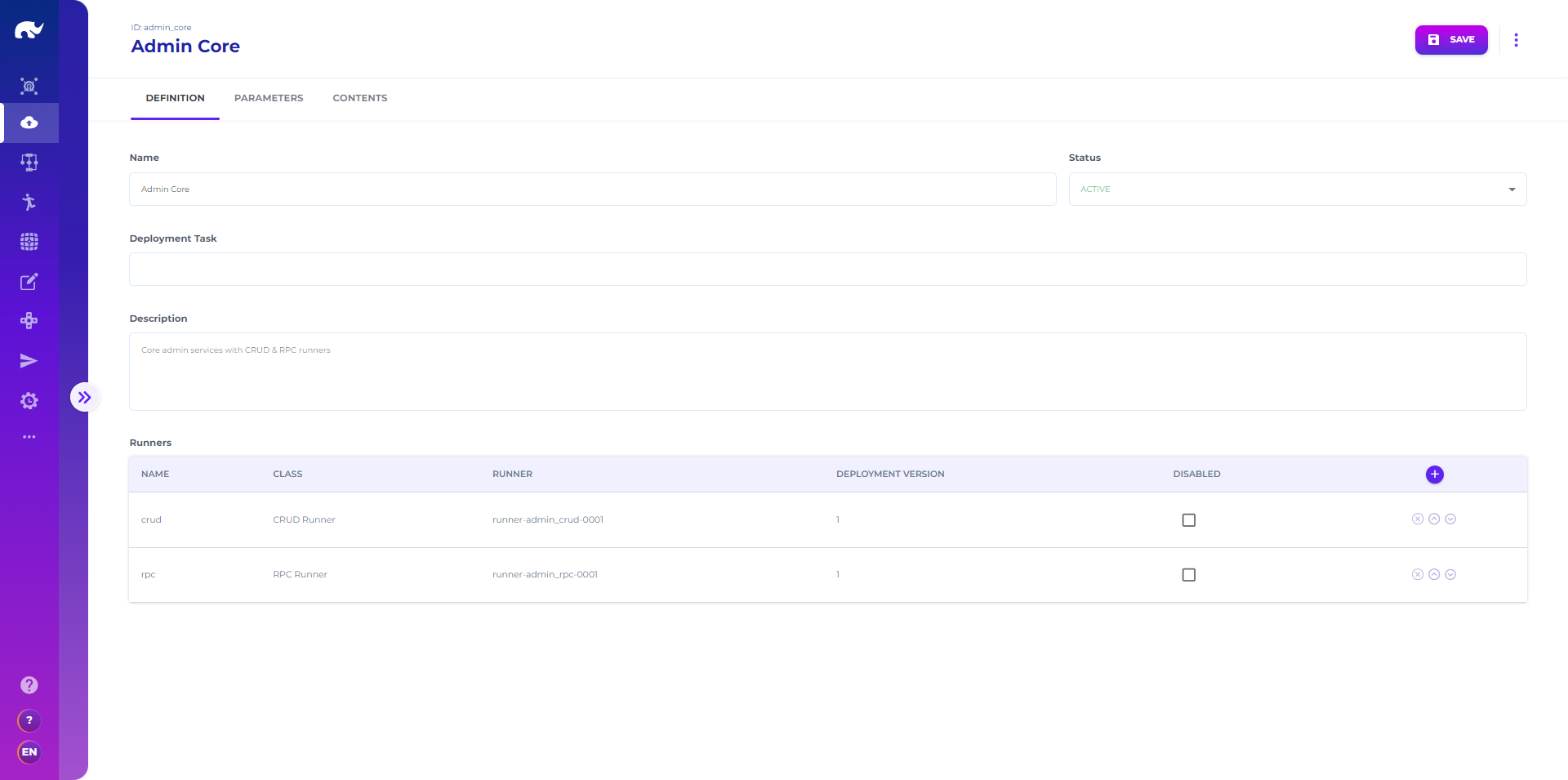
Deployments are sets of runners which are deployed on a specific machine, node or pod.
Deployment UI
Deployments allow grouping of runners into physical components, as well as configurations for deploying same runners on different infrastructure (e.g. different cloud providers, different containerization models) based on business and technical requirements.
In the most typical scenario, a deployment package bundles a few runners, specifies kubernetes deployment parameters such as namespace, node pool, rierino version and replica count, which results in deployment of a Java application using Rierino's in-cluster deployer web service and kubernetes job running ansible playbooks and helm charts. However, it is possible to 100% customize this deployment model, since the deployment activity is basically a Rierino backend API call with the deployment package ID, which can easily trigger a Jenkins job for an on-prem deployment, etc. It is even possible to use deployment packages for non-runner deployments (e.g. ui, gateway, etc.) with minimal customizations on the deployment API design.
---
# Agent Instructions
This documentation is published with GitBook. GitBook is the documentation platform designed so that both humans and AI agents can read, navigate, and reason over technical content effectively. Learn more at gitbook.com.
## Querying This Documentation
If you need additional information that is not directly available in this page, you can query the documentation dynamically by asking a question.
Perform an HTTP GET request on the current page URL with the `ask` query parameter, and the optional `goal` query parameter:
```
GET https://docs.rierino.com/devops/microservices/deployment-packages.md?ask=&goal=
```
`ask` is the immediate question: it should be specific, self-contained, and written in natural language.
`goal` is optional and describes the broader end goal you are ultimately trying to accomplish on behalf of the user. GitBook uses it to tailor the answer towards what is most useful for that goal.
The response will contain a direct answer to the question and relevant excerpts and sources from the documentation.
Use this mechanism when the answer is not explicitly present in the current page, you need clarification or additional context, or you want to retrieve related documentation sections.