> For the complete documentation index, see [llms.txt](https://docs.rierino.com/llms.txt). Markdown versions of documentation pages are available by appending `.md` to page URLs; this page is available as [Markdown](https://docs.rierino.com/examples/training-examples/exercise-create-a-crud-service.md).
# Exercise: Create a CRUD Service
This page lists an exercise for adding a new MongoDB-backed state to Train CRUD and exposing it as a /test endpoint.
This exercise extends the existing **Train CRUD** runner with a new state. The result is a new CRUD endpoint under the runner. The endpoint reads and writes to a MongoDB collection automatically.
### Before you start
* You can access the **Devops** app.
* The training deployment is installed and `train_crud` is running.
* You know your API base URL: `https://[YOUR_ADMIN_API_DOMAIN]`.
### What you’ll build
* A new state with alias `test`.
* A new endpoint: `https://[YOUR_ADMIN_API_DOMAIN]/api/request/train_crud/test`
{% stepper %}
{% step %}
### Open the Runner screen
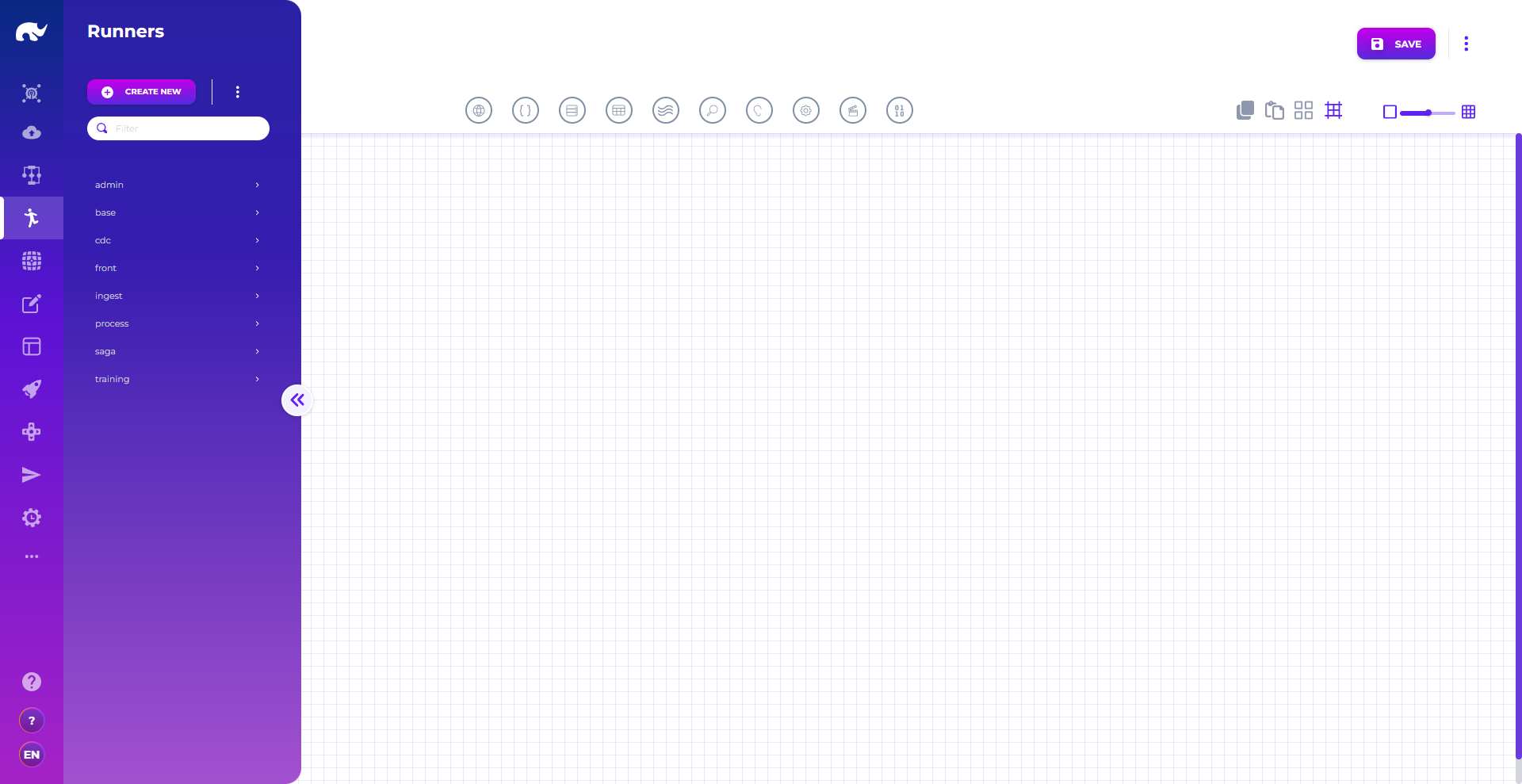
Open the [Runner](/devops/microservices/service-runners.md) screen from the [Devops](/devops/devops-overview.md) app.
Unless you changed routing, the UI is at `https://[YOUR_ADMIN_UI_DOMAIN]/app/devops/common/runner`.
Runner UI
{% endstep %}
{% step %}
### Select Train CRUD
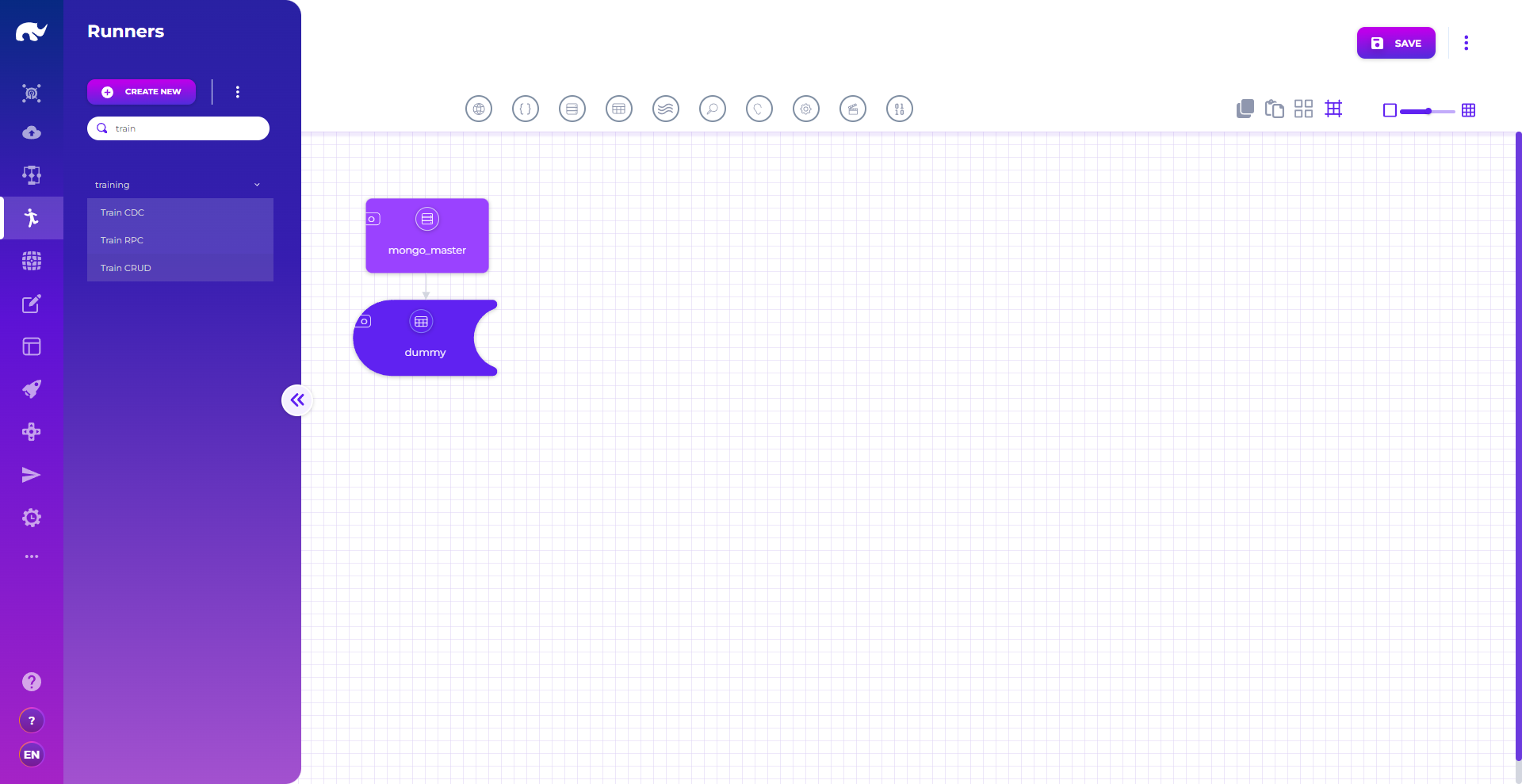
In the left runner list, filter and select **Train CRUD**.
Train CRUD Runner
{% endstep %}
{% step %}
### Add a new State element
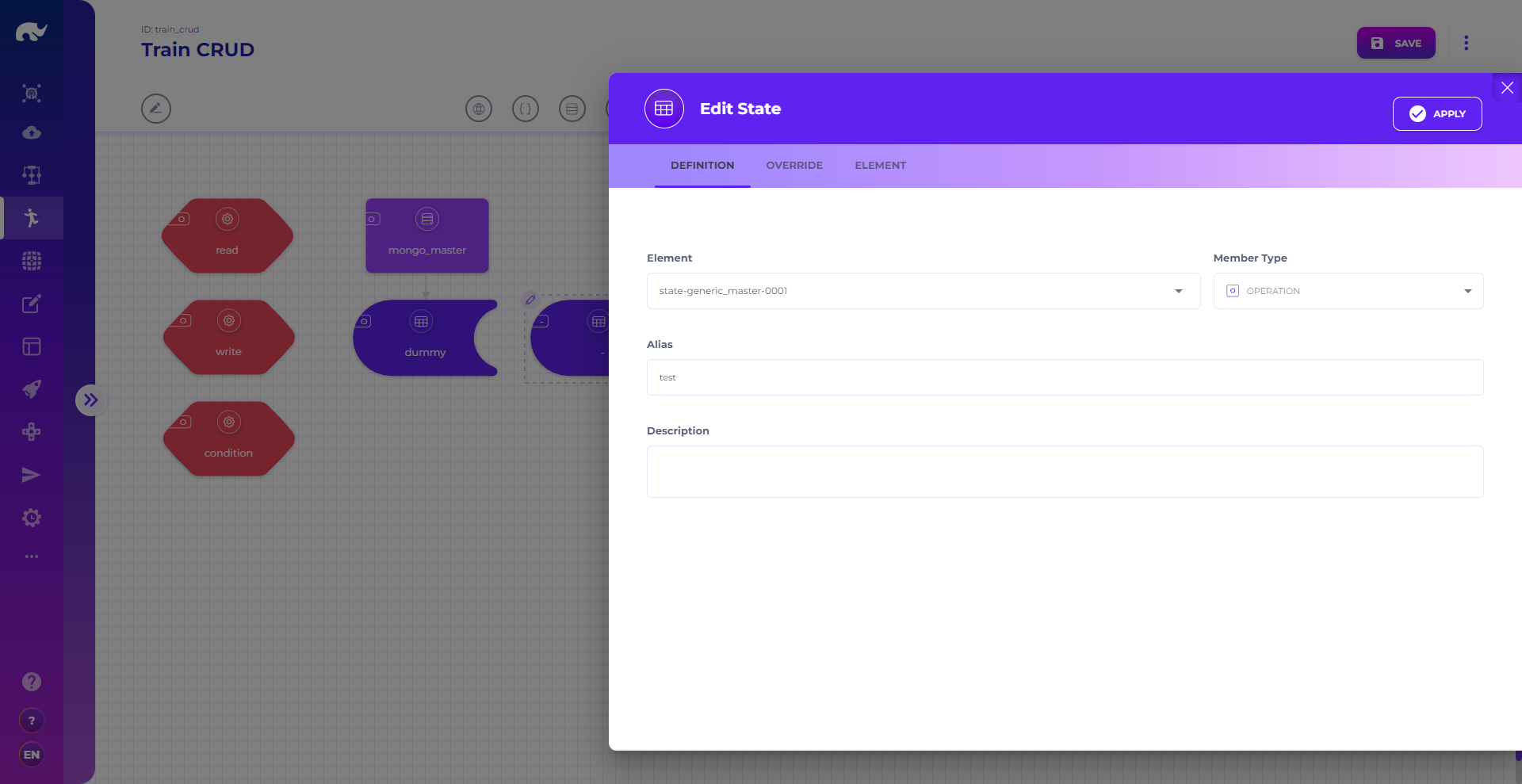
Drag a **State** element (table icon) from the stencil onto the runner diagram.
Select the new element. Click the pencil icon to edit it.
New State Manager
{% endstep %}
{% step %}
### Configure it as Generic Master + alias `test`
In the editor:
* Choose **Generic Master**.
* Set **alias** to `test`.
`Generic Master` creates a simple MongoDB-backed state manager on the `master` database. The **alias** becomes:
* the CRUD URL segment (`/test`)
* the MongoDB collection name (`test`)
This is the simplest “new CRUD resource” configuration. For advanced options, use the Devops docs referenced from the CRUD runner section.
{% endstep %}
{% step %}
### Wait for rebuild and test the endpoint
The training Train CRUD runner is typically configured to rebuild every \~30 seconds. After you save, give it a moment to apply the new state.
Then call:
`https://[YOUR_ADMIN_API_DOMAIN]/api/request/train_crud/test`
Expected result:
* HTTP `200 OK`
* Body: `{list: []}` (the collection starts empty)
Full list of supported CRUD operations and parameters is in [CRUD event runner](/devops/microservices/service-runners/deploying-runners/spring-runners.md#crud-event-runner).
{% endstep %}
{% endstepper %}
### Troubleshooting
* **404 Not Found**: confirm the alias is `test` and that you saved the runner. Then wait for the rebuild interval.
* **500 errors**: `Generic Master` points to a MongoDB connection. Check the master DB is reachable.
* **Endpoint exists but returns nothing**: verify you are hitting `train_crud` (URL contains `/train_crud/`).
---
# Agent Instructions
This documentation is published with GitBook. GitBook is the documentation platform designed so that both humans and AI agents can read, navigate, and reason over technical content effectively. Learn more at gitbook.com.
## Querying This Documentation
If you need additional information that is not directly available in this page, you can query the documentation by asking a question.
Perform an HTTP GET request on the following URL with the `ask` and `goal` query parameters:
```
GET https://docs.rierino.com/examples/training-examples/exercise-create-a-crud-service.md?ask=&goal=
```
`ask` is the immediate question: it should be specific, self-contained, and written in natural language.
`goal` is what the user is ultimately trying to achieve, the reason they need the answer. Sharing it helps GitBook give you a better, more relevant answer. A goal is most helpful when it describes the outcome the user wants rather than restating the question. For example, with `ask=how do I create an API token`, a goal like `automate deployments from our CI pipeline` lets GitBook tailor the answer to that use case.
The response will contain a direct answer to the question and relevant excerpts and sources from the documentation.
Use this mechanism when the answer is not explicitly present in the current page, you need clarification or additional context, or you want to retrieve related documentation sections.